Introduction
In today’s digital business world, customer data has become one of the most valuable assets for every company. Businesses interact with customers through websites, emails, social media, phone calls, online stores, and customer support channels every day. These interactions create a large amount of information that businesses must organize and manage properly.
However, managing customer information manually can become difficult, especially as businesses grow. Disorganized customer data often leads to communication gaps, missed opportunities, poor customer service, and lower productivity.
This is where CRM becomes essential.
CRM, or Customer Relationship Management, helps businesses collect, organize, store, analyze, and manage customer data efficiently. Modern CRM systems provide businesses with a centralized platform where all customer information can be accessed easily and securely.
At Cubetechworld, we believe effective customer data management is one of the key factors behind successful business growth. CRM systems not only improve customer relationships but also help businesses increase efficiency, improve decision-making, and deliver personalized customer experiences.
In this blog, we will explore how CRM helps businesses manage customer data effectively, why customer data management is important, and how CRM supports long-term business success.
What is CRM?
CRM stands for Customer Relationship Management.
It is software designed to help businesses manage:
- Customer information
- Sales activities
- Communication records
- Marketing campaigns
- Customer support interactions
CRM systems store all customer-related information in one organized platform.
This helps businesses:
- Improve communication
- Build stronger customer relationships
- Increase sales opportunities
- Improve business efficiency
CRM acts as a complete customer management solution for modern businesses.
What is Customer Data?
Customer data refers to all information businesses collect about customers during interactions.
This data may include:
- Names
- Phone numbers
- Email addresses
- Purchase history
- Website activity
- Customer preferences
- Social media interactions
- Support tickets
- Payment details
Customer data helps businesses understand:
- Customer needs
- Buying behavior
- Interests
- Communication preferences
Businesses can use this information to improve customer experiences and business performance.
Why Customer Data Management is Important
Customer data management is extremely important because it helps businesses:
- Understand customers better
- Improve communication
- Personalize services
- Increase customer satisfaction
- Improve sales and marketing strategies
Without proper data management, businesses may experience:
- Lost customer information
- Duplicate records
- Poor communication
- Missed follow-ups
- Reduced customer trust
Organized customer data improves overall business operations and customer relationships.
How CRM Helps Businesses Manage Customer Data Effectively
CRM systems are designed specifically to simplify customer data management.
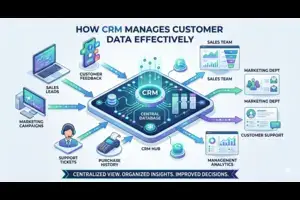
1. Centralized Customer Information
One of the biggest advantages of CRM is centralized data storage.
Instead of storing information across:
- Emails
- Spreadsheets
- Paper documents
- Multiple software systems
CRM stores everything in one platform.
Businesses can easily access:
- Customer profiles
- Communication history
- Sales records
- Support interactions
This improves organization and reduces confusion.
Centralized data also saves time for employees.
2. Organizes Customer Data Efficiently
CRM systems organize customer information in structured formats.
Businesses can categorize data based on:
- Customer location
- Purchase behavior
- Sales stages
- Interests
- Communication history
Organized data helps businesses:
- Locate information quickly
- Improve workflow
- Increase efficiency
Proper organization also reduces the risk of data loss.
3. Tracks Customer Interactions
CRM systems record every interaction between businesses and customers.
This includes:
- Emails
- Phone calls
- Website inquiries
- Social media messages
- Customer support requests
Tracking interactions helps businesses:
- Understand customer needs
- Improve communication
- Maintain consistency
Businesses can view complete customer histories at any time.
This creates better customer experiences and improves service quality.
4. Improves Customer Communication
Good communication is essential for customer satisfaction.
CRM systems help businesses:
- Send personalized emails
- Schedule follow-ups
- Respond quickly to inquiries
- Manage communication history
Businesses can communicate more professionally and consistently.
Customers appreciate fast and personalized responses.
Improved communication strengthens customer trust and loyalty.
5. Enhances Customer Personalization
Modern customers expect personalized experiences.
CRM systems collect information about:
- Customer interests
- Purchase history
- Browsing behavior
- Communication preferences
Businesses can use this data to provide:
- Personalized offers
- Product recommendations
- Customized emails
- Targeted advertisements
Personalization improves:
- Customer satisfaction
- Engagement
- Conversion rates
Customers are more likely to trust businesses that understand their needs.
6. Helps Sales Teams Manage Leads
CRM systems improve lead management and sales tracking.
Sales teams can:
- Capture leads
- Track customer journeys
- Schedule follow-ups
- Monitor opportunities
CRM provides valuable insights into:
- Interested customers
- Sales progress
- Customer buying behavior
This helps businesses close deals more effectively.
Improved sales management increases revenue opportunities.
7. Improves Marketing Strategies
CRM systems help marketing teams understand customers better.
Businesses can analyze:
- Customer behavior
- Campaign performance
- Purchase trends
- Audience interests
This helps create:
- Personalized marketing campaigns
- Better email marketing
- Targeted promotions
Data-driven marketing strategies improve engagement and ROI.
8. Automates Repetitive Tasks
CRM systems automate many routine activities.
Examples include:
- Sending welcome emails
- Scheduling reminders
- Updating records
- Tracking communication
Automation saves time and reduces manual work.
Employees can focus more on:
- Customer relationships
- Business growth
- Strategic planning
Automation also improves accuracy and efficiency.
9. Improves Customer Support
Customer support teams need fast access to customer information.
CRM systems help support teams:
- View customer histories
- Track complaints
- Solve issues faster
- Provide personalized support
Better support improves:
- Customer satisfaction
- Brand reputation
- Customer loyalty
Happy customers are more likely to remain loyal to the business.
10. Provides Data Security
Customer data security is extremely important.
Modern CRM systems include:
- Secure cloud storage
- User access controls
- Data backups
- Encryption protection
This helps businesses protect sensitive customer information.
Secure systems improve customer trust and business credibility.
11. Improves Team Collaboration
Different departments often need customer information.
CRM systems allow:
- Sales teams
- Marketing teams
- Customer support teams
to access the same updated customer data.
This improves:
- Communication
- Coordination
- Workflow efficiency
Better collaboration leads to improved customer experiences.
12. Helps Businesses Make Smarter Decisions
CRM systems collect valuable customer and business data.
Businesses can analyze:
- Customer behavior
- Sales performance
- Marketing results
- Business trends
This helps businesses make informed decisions.
Data-driven strategies improve:
- Customer satisfaction
- Revenue growth
- Operational efficiency
Smart decisions support long-term business success.
13. Reduces Human Errors
Manual data management often causes:
- Duplicate records
- Missing information
- Communication mistakes
CRM systems reduce errors through:
- Automated updates
- Structured organization
- Accurate data storage
Reliable information improves business operations and customer trust.
14. Supports Business Growth
As businesses grow, customer management becomes more complex.
CRM systems help businesses:
- Manage larger customer databases
- Improve organization
- Scale operations efficiently
CRM provides a strong foundation for long-term growth and expansion.
Businesses can grow without losing control over customer relationships.
Role of AI in CRM Data Management
Artificial Intelligence is making CRM systems smarter and more efficient.
AI-powered CRM can:
- Predict customer behavior
- Analyze customer trends
- Automate communication
- Recommend actions
- Improve personalization
AI helps businesses manage customer data more intelligently and efficiently.
Benefits of CRM for Small Businesses
Small businesses often struggle with organizing customer information.
CRM helps small businesses:
- Save time
- Improve communication
- Increase sales opportunities
- Organize customer data
- Build customer loyalty
Affordable cloud-based CRM systems make advanced customer management accessible for small businesses.
Benefits of CRM for Large Businesses
Large businesses manage huge amounts of customer data daily.
CRM helps large businesses:
- Improve coordination
- Analyze customer behavior
- Manage complex operations
- Deliver personalized experiences
CRM improves scalability and operational efficiency.
Industries That Use CRM Systems
CRM systems are used across many industries, including:
- Retail
- Healthcare
- Real estate
- Banking
- Education
- E-commerce
- Digital marketing
Any business managing customers can benefit from CRM solutions.
Common Challenges Without CRM
Businesses without CRM often face:
- Disorganized data
- Missed follow-ups
- Poor customer communication
- Low productivity
- Customer dissatisfaction
CRM systems help solve these challenges effectively.
Future of CRM and Customer Data Management
CRM technology continues evolving rapidly.
Future trends include:
- AI-powered automation
- Predictive analytics
- Voice-enabled CRM
- Advanced personalization
- Cloud-based platforms
Businesses using future-ready CRM systems will gain stronger competitive advantages.
Why Businesses Need Professional CRM Solutions
Implementing CRM systems properly requires planning and expertise.
Professional CRM services help businesses:
- Select suitable CRM platforms
- Customize CRM systems
- Train employees
- Improve CRM performance
Expert guidance helps businesses maximize CRM benefits.
Why Choose Cubetechworld for CRM Solutions?
At Cubetechworld, we provide advanced CRM solutions designed to improve customer data management and business growth.
Our CRM services include:
- CRM setup and integration
- Customer data management
- AI-powered automation
- Sales tracking
- Marketing automation
- Analytics and reporting
We create customized CRM strategies based on business goals and customer needs.
Our mission is to help businesses strengthen customer relationships and achieve sustainable digital growth.
Conclusion
Customer data is one of the most important business assets in the digital world. Managing this data effectively is essential for improving customer relationships, increasing efficiency, and supporting long-term growth.
CRM systems help businesses:
- Organize customer information
- Improve communication
- Personalize customer experiences
- Increase sales opportunities
- Improve customer support
- Make smarter business decisions
Businesses that use CRM effectively can build stronger customer relationships and achieve sustainable success in competitive markets.
As technology continues evolving, CRM systems will become even more important for modern business growth.
At Cubetechworld, we help businesses build smart CRM systems designed for future-ready customer management and digital success.
.webp)
.webp)